Posts

Showing posts matching the search for kayak

Kayak, Canoe, or Paddleboard?

Image
Kayaking on Vermillion Lake in Banff National Park, Alberta. I went out this morning for "a paddle" on a nearby waterway on one of my kayaks.  I am fortunate in that there are a dozen lakes, rivers, creeks, and other bodies of water within twenty minutes of where I live.  A little further gets me to saltwater.  While paddling along I met two other similar-minded people, one in a canoe and the other on a paddleboard. That was it, just the three of us, on the water, traveling along the fluid highway without a care in the world.  Getting out on the water, regardless of method, is an excellent way to relax and enjoy the surroundings.  It is also a great chance to see nature.  I was not disappointed as this morning I saw two bald eagles, several pairs of common mergansers, herons, swallows, and one beaver that came surprisingly close to my boat.  I talked with my fellow oarsmen in passing and we discussed boats of choice.  Since each of us was ...

Making a memory - the art of illusion.

Image
1.  Two Jack Lake  2.  Charles in kayak  3.  The illusion of Charles at Two Jack Lake. The fact is that we were both at Two Jack Lake in Banff, but my friend, Charles, wanted a picture of himself in frame-1 as opposed to the image I had of him in frame-2 .  And so, I was given the challenge of making it work.  In order to do this a number of steps were required (below).  The result was frame-3; it was made into an 11x14 inch print which he now has hanging on a wall at his house. take the raw image of frame-1 and create an 11x14 @300dpi file of it in Photoshop. take the raw image of frame-2 and select the image of Charles in his kayak.  I used the polygon lasso tool to do this with 0 feathering.  Copy it paste the copied image from frame-2 into frame-1.  Flip the image horizontally using the Edit/Transform menu command and rotate it a few degrees clockwise using the Free-rotate function.   use the eraser tool with a soft e...

The boat loving wiener dog.

Image
Keisha, our first dachshund, loved boating with us. We introduced Keisha to boating when she was still a puppy.  Her place was at the front of the boat, preferably on the deck of whatever canoe or kayak she was on.  Her balance was amazing; no matter the waves or rocking motion of the craft, she proudly became the vessel's figurehead. If, for whatever reason, she was left ashore with a family member while another plied the waters nearby, she would let her displeasure be known to all within earshot.  Unconsolable, her boisterous vocalizations would go on until the paddler returned to include her in whatever adventure was about to happen.   Although she liked to be on the water, she did not care to be in it.  We all tended to share that point of view.  Although she would paddle with any family member, she preferred to be with my wife, Kathryn, to whom she was closest.  She would even give up her post as lead dog to sit inside the kayak's cockpit w...

Why I love to kayak.

Image
Western Painted Turtles crowding on a log at Dutch Lake, near Clearwater. Being on the water is an excellent way to experience nature.  It doesn't work well if you are on a large vessel like a cruise ship though, you have to get close to the action and be small enough to not influence it significantly.  I find kayaking is the best way to achieve this. As a photographer, I want to be as close to my subjects as possible without affecting behaviour.  I use a camera with a relative focal length lens between 400 and 900 mm.  This usually allows me to get a full framed view of many medium-sized birds from a discrete viewing distance.  The above photo was shot at 460 mm (690 relative); I had to reduce my lens' focal length as I was too close - which is rarely ever a problem. I have used both canoes and kayaks to approach and photograph wildlife.  Of the two I find that kayaks are better suited because of their ability to control them.  My Delta 15-5 k...

Kayaking with Charles

Image
A few of the memorable kayak trips I have taken with Charles The center image was taken on Cedar Lake in the Sunshine Valley this year.  Other shots include being on Dutch Lake, the Fraser River, Jack Fish Lake, the Gulf Islands, and a few others I can't quite remember.  Besides all these enjoyable paddles, we have done the Broken Islands (twice), the Red Deer River (twice), a few other rivers in both BC and Alberta, and a host of others. I don't kayak as often as I used to, but every time I get out on one of my boats I am convinced it is the best place in the world to be.  I love the fresh air, the early morning energy, and the abundant wildlife I see.  Many of my best creature photos have come when on a kayak.   There is still a lot I want to do, and I have no doubt that much of it will be done with my buddy.  I do, on occasion, go out on my own.  This is especially true if we are camping near a body of water and I can just stroll down and hop i...

A Muskrat Tale.

Image
Although we have muskrats here in BC, I have never seen one. I lived in Alberta for 10 years and saw plenty of them. While visiting north of Edmonton I borrowed a kayak and went out on a lake for a paddle. There I had an unexpected encounter. I had just finished a trip to the long end of the lake and had turned around to head back. Ahead of me, not 40 meters, a furry animal entered the water and proceeded to swim parallel to the shoreline going in the same direction. I wasn't immediatly sure what it was but as I gained on the hard swimming creature it dawned on me that it must be a muskrat. Beavers are larger, possess a wide, flat tail, and usually announce the presence of strangers with a loud slap of it on the water's surface just before disappearing leaving a trail of bubbles. This beast just kept swimming. I paddled quietly behind it, slowly gaining ground, or in this case, water. Once I was within about 3 meters it began to show signs of anxiety by diving und...

The lens makes a difference.

Image
  As I have lived in the Lower Mainland of BC for 30 years, I have had many opportunities to photograph great blue herons.  Over that period of time I have photographed them with negative and slide film and a host of digital sensors.  Although the camera has had some impact on the quality of the image I could attain, I have to say that the real deciding factor has been the lens. My field equipment reflects my passion for wildlife.  I have owned about a dozen different lenses with a focal length of 200 mm or more.  These include a number of prime lenses (2 - 200 mm f/4 lenses, 2 - 300 mm lenses {f/4 and 4.5}, and 2 - 500 mm lenses {an f/8 mirror and f/5.6 PF).  I have also owned a number of zooms including a 100-300, a 28-300, an 80-400, and two 150-600s.  I have also used a 1.7x and a 2x teleconverter. All of them have allowed me to photograph wildlife, but I have to say that, in general, the primes are superiour to zooms.  Longer focal lengths me...

What's your passion? Find ways to embrace the things you love.

Image
I love photographing wildlife from my kayak. I enjoy photography, so much that it has shaped my life in many ways.  And, although I have had the opportunity to shoot across a wide range of subdisciplines, my preferences always take me back to shooting outdoors.  More specifically, photographing wildlife. I teach photography as a home business, and one of the things I tell my students is to determine what their passions are.  I tell them to buy equipment and look for opportunities to explore those things that are important to them.  My focus, of course, is photography, but the idea includes all areas of life. From the standpoint of photography, it means buying equipment that will allow you to step up beyond whatever limitations currently restrict you.  For example, many people own a generic "kit" telephoto lens such as a 55-300mm f/4-5.6 lens that gives them telephoto abilities.  Although this is true, such a lens does not even remotely compare to a good 80-...

Bald Eagle - Continuous versus Single point focus.

Image
Bald Eagle on the bank of the Columbia River, near Golden, BC.   In previous blogs, I had mentioned that I did a solo kayak trip along the upper reaches of the Columbia River, near Golden, BC.  I had an APS-C sensor camera equipped with an 80-400 mm zoom lens, which was used mostly at the 400 mm focal length.  As I rounded a bend in the river I came across a bald eagle and its recently fledged (and now very large) chick.  I got a number of shots off of both, but none with them together.  Whether a subject is changing its position relative to you, or you are changing your position relative to it, or even both at the same time, there is a problem with focusing.  Most of the time I try to keep still while peering through my viewfinder.  I always prefer my subject to be stationary and compliant, but the truth is there are plenty of exceptions to both situations.  In the case regarding the above photo, I was travelling downstream.  As I moved forw...

Western tanager - three sightings in two days!

Image
Western tanager eating an insect, Kentucky / Alleyne Provincial Park near Merritt, BC. I remember seeing my first western tanager many years ago; it was at a distance, but the moment remains burned in my mind.  It was a long time before my second sighting, and then, while camping near Merritt, I saw one on three separate occasions.   The above photo was the first of the three encounters.  I must have gotten forty photos.  The cool thing was that it saw an insect about ten feet away from me; it flew down from the tree, picked it up, and returned.  That was an amazing moment!   The second encounter happened while I was paddling my kayak.  I was near the shore of Kentucky Lake when a tanager flew down, landed in the water, and started bathing.  I brought a camera and long lens with me for just such an opportunity (I keep it in a case or a waterproof bag) and took more photos.  One is below. Western tanager bathing in the cold waters of...

Surf Scooter - a rare bird in these parts

Image
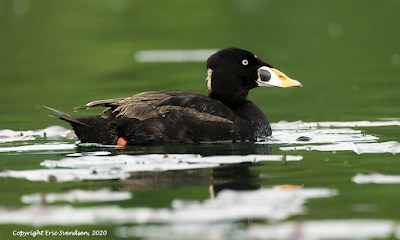
A male surf scooter floating on Dutch Lake a long way from home. I saw a dark coloured bird on the lake's surface two days ago and wondered exactly what it was I was looking at.  I can generally place a bird within reason and usually have some idea of what I am looking at.  This totally stumped me; I have never seen anything like it. Today I was out on my kayak and there it was again, this time in a bed of lily pads resting.  I had my long lens (150-600 Tamron) handy and got a few good shots of it.  Very unusual bill and an odd white spot on the back of its head.  Then there were the white eyes with the dark center that really stood out.  I had photographed something unusual to be sure. When I got back to the RV and referenced my bird books (I bring 4 or 5 of them with me when I travel), I discovered I had seen a Surf Scooter.  OK, that's a new one to me.  I had another look at the texts and they breed far north of here, not too far from the Yukon...

Blue winged teal on the wing and a large memory buffer.

Image
Teals are a type of duck, albeit smaller than more familiar species like mallards.  They are social birds and tend to be in groups; undoubtedly they benefit from having multiple eyes on the environment for potential predators.  In North America there are three species of teal which include cinnamon teals, green-winged teals, and blue-winged teals (shown above).  The sky-blue patch of convert feathers and the white stripe on the face are good indicators of the species.  Secondaries are emerald-green in colour.  The brilliant wing hues are not visible when the duck is at rest. I have seen plenty of green-winged teals along the BC coast but didn't get a good look at a blue-winged teal until I spent time around Edmonton.  These birds are actually present throughout most North America, although they are absent from Canada's west coast area.  They are mostly freshwater species and feed in shallow ponds by upending themselves into a vertical profile to reach ...

Teaching children about birds.

Image
Birds I photographed at Lac Bellevue, Alberta, in 2016. I visited my daughter, Leanne, when she was a camp counsellor at Alberta's Lac Bellevue, seven years ago in 2016.  While there I plied the waters with my kayak and photographed many of the wetland birds I saw.  The diversity was astonishing; in fact, two different species I have not photographed before or since. If you ask a child about the types of wild birds they know, the chances are they will tell you about robins, crows, and house sparrows.  They may also have a general idea about ducks and gulls.  Outside of that, it is unlikely they could identify a hawk from a falcon, a sandpiper from a plover, or even a wren from a finch.  I think it could be said that many adults would have the same problem. This is the heart of the matter.  Adults don't know, and so neither do children.  Most teachers are not familiar with local fauna and the curriculum generally does not require them to be.  Paren...

Photographing the sun using HDR.

Image
The sun is incredibly bright; so bright in fact that including it in an image will likely wash out much of the image. Expose for the sun and everything else is a silhouette. Expose for everything else and the sun overpowers much of the scene. One of the best solutions I have found for this is using a technique called HDR. HDR stands for high dynamic range. The dynamic range of any visual media is the number of stops between absolute black and absolute white. Many scanners only have a dynamic range of 4 or so while jpegs from a digital camera run around 8. A decent DSLR will give you a dynamic range of 12 when used in RAW mode. Although this represents the caputure of a huge range of light values, it is just not enough in some cases. Photographing an early morning scene with the sun in it where you want details in all areas is a good example. The fact is that even the best RAW capture will not have enough range to get it all. Enter HDR. I have used HDR built into some ...

Surf Scooter - an accidental visitor?

Image
Surf scooter on Dutch Lake. I saw a dark coloured bird on the lake's surface two days ago and wondered exactly what it was I was looking at.  I can generally place a bird within reason and usually have some idea of what I am looking at.  This totally stumped me; I have never seen anything like it. Today I was out on my kayak and there it was again, this time in a bed of lily pads resting.  I had my long lens (150-600 Tamron) handy and got a few good shots of it.  Very unusual bill and an odd white spot on the back of its head.  Then there were the white eyes with the dark center that really stood out.  I had photographed something unusual to be sure. When I got back to the RV and referenced my bird books (I bring 4 or 5 of them with me when I travel), I discovered I had seen a Surf Scooter.  OK, that's a new one to me.  I had another look at the texts and they breed far north of here, not too far from the Yukon and NWT borders.  Surf Scoo...

Male and Female Common Yellowthroat

Image
Female common yellowthroat with nest building supplies. Male common yellowthroat. I live about 15 km or so from a bird sanctuary.  Every once in a while I enjoy a sojourn there, either sitting blissfully on a kayak or meandering along a dike.  Camera in hand, there is a sense of peace as I am surrounded by the sounds, sights, and smells of nature.  There is no better way to spend a day. I had the good fortune to go for a walk with a buddy of mine through this paradigm of tranquility.  He had come upon a path I knew nothing about and shared his discovery with me.  Getting there required embarking on a seriously potholed road.  My teeth chattered while I flung my jeep along the pit covered surface trying to miss more holes than I hit.  My success was limited.  Once past the cavity laced byway we reached our destination. There are a number of dykes here which function both as a means of flood control and environmental management.  B...

Taking the good with the bad.

Image
Star Lake Resort, about 10 km west of Clearwater, BC. You would think that in the Time of the GPS that it would be easy to find your way from Point A to Point B.  Afterall, it only requires putting the name of the destination into your G uaranteed P recision  S ite finder and push a button to receive directions.  What's even better is that you can use all this technology in a variety of forms.  There is the cell phone, a proprietary GPS device such as Garmin, and built-in units that are part of your auto's dashboard. There is what you should be able to do and then there is what you can actually do.  One of my first disappointments was trying to find a Golden Corral  down in the US a number of years ago.  We were in Galveston looking for an eatery and thought it would be good to go there.  After entering the name of the establishment into the device we were told the nearest one was several hundred miles away from us.  Disappointed, we lo...

My buddy and I are at it again.

Image
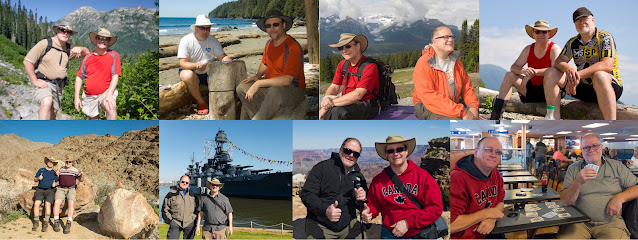
Charles and Eric on various excursions. Charles, a long-time friend, and I have done a lot of travelling together.  Just some of the adventures include New Zealand, Arizona, Texas, Juan de Fuca and West Coast trails, Broken Islands, Ontario, the Maritimes, the Yukon, and vast trips throughout BC and Alberta.  The list is impressive. We met at college in 1978 and have been hanging out together since then.  Our friendship has passed through all the milestones adults go through.  We were in each other's wedding parties, saw our children grow up and move out, retired, and through all of that we took the time to get together in spite of the fact that we live in different provinces. As we get older our abilities have ebbed.  Health problems have been creeping up and our backpacking and kayak touring expeditions have turned into RVing with a big-screen TV.  Even here we rouse each other onto adventures, although now e-bikes are our mount of choice.  And, as a...

New dragonfly species - to me.

Image
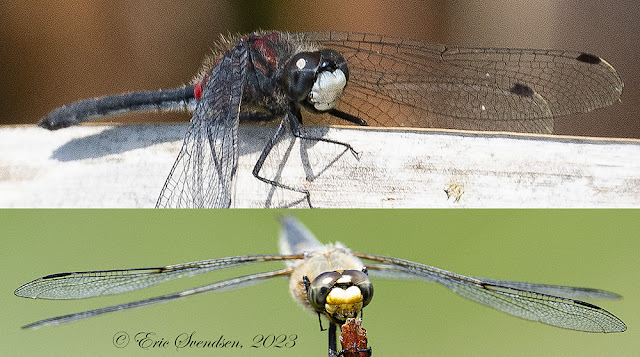
Crimson-winged white-faced dragonflies.  Male (above) and female (below). As a boy, I would spend hours along nearby streams and ponds watching and collecting aquatic insects.  This was mostly in southern Ontario but I found the passion followed me when we moved to Alberta back in the 70's.  Even now, I cannot see a body of fresh water without looking for what interesting invertebrate fauna may present itself.   While camping in Leduc, Alberta, I put my kayak in the water at a nearby retention pond.  Although it is artificial in nature, being a man-made hole used to manage runoff, succession has made its mark and it now resembles a fairly advanced ecosystem with a wide range of inhabitants.  That's one of the beautiful things about nature; we can mess it up terribly but its perseverance will eventually make amends if left alone.  I saw a family of bufflehead ducks, a muskrat, damselflies, mayflies, and an army of dragonflies competing for space, m...

Murphy and I kayaking Two Jack Lake in Banff

Image
I have always enjoyed kayaking with our dogs.  They sit well in the ensconced seating area and are far enough from me that there is no interference with paddling.  This was a new experience for Murphy.  Of the five dachshunds we owned, only one liked to sit on top of the kayak's deck rather than be in it.  That was our first doxie, Kiesha.   Kiesha with my daughter, Leanne. If you want to get noticed on the water, paddle with a cute dog.  I have paddled in many places and generally go unnoticed.  Have a wiener dog with you and suddenly you become the center of attention.  Kids point, ladies smile, and even crusty old salts such as myself become enamoured.  The dog loves to be in attendance with its human, even on the water, and it only gets better when dragonflies come near to land on the boat.  Suddenly you hear a rapid snapping sound and a blur of activity as the beast attempts to impale the offending insect with its teeth. ...