Posts

Photographing creatures in the wild

Image
Giant Golden Orb Weaver spider. More than half of the challenge of getting photographs of creatures in nature is finding them in the first place.  You have to be where the organisms live, you have to be there when they are actually out and accessible, and you have to be inconspicuous in the process.   If all that goes well, then the is the need to have the right equipment, that there is enough light, and that you can use those things in combination to get a decent exposure that is focused.  If that isn't enough, there is the hope above hopes that you will also get an image that is attractive or shows the creatures engaging in some interesting behaviour.   I have read accounts of photographers spending months in the bush, living in blinds or exposed to the elements, and taking literally thousands of photographs in order to just get one really good image.  That's not me, mostly because I value my comforts and photograph happenstance opportunities as they...

Time - our greatest gift.

Image
Water balloon fun at Grace Baptist Church VBS (Vacation Bible School). One of the most important resources we have to offer is our time.  More specifically, time spent helping others, contributing, and making a difference.  Money doesn't have to be involved, although it is another resource often in great need.  And you don't have to make an exhausting effort or expend every spare second available.  You just have to be there. What I am talking about is volunteering.  Building the community, helping those in need.  The opportunities are boundless.  Any organization involved in serving people would benefit from another pair of hands.  Scouting, sports, clubs, rescue, food banks, seniors, schools, churches, camps; all need people who can give of their time.  A few hours here and there helps, although it's better to lend assistance on a regular basis.  All you need to bring is yourself.  Whatever skills you have is included in that packa...

Have you ever wondered, "What if I ..."?

Image
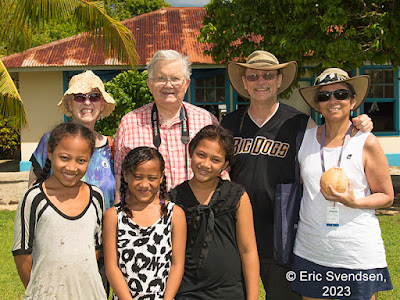
Kathryn and I on Somoa. There are points along our timelines that represent critical moments of decision.  Making one choice over another inevitably causes events to unfold in very different and unique manners.  Outcomes rapidly change throughout our lives as time unfolds and will likely produce results that are drastically different from the way things are today. Fortunately, such critical moments are few and far between.  What one eats for dinner, the particular shirt worn on any day at random, and either riding your bike or running for exercise, will not likely impact what the rest of your life looks like.  It's those events that take us down a particular path that paves the way to our future.  Who you marry, the job you train for and take, and the degree of risk-taking you commonly employ will produce far-reaching ramifications. Have you ever wondered, "What would have happened if I had ...?"  I certainly have, and I think back along the time-stream rep...

What being a grandparent means

Image
My wife, Kathryn, with our grandchild, Nora. It seems that every milestone in life comes with its own learning curve.  We are not born with the innate knowledge of how to raise children and, it seems, that much of our understanding is based upon how we ourselves were raised.  We take our preconceptions and move forward as best as we can.  We are fortunate that we can learn from our mistakes and that those we raise are pliable enough to overcome them. My granddaughter, Nora, is about two and a half now.  Being that she is my first (and only - for the moment) grandchild, I have been learning what it means to be a grandparent.  I discovered that my attempts to discipline her were unwelcome when her parents were present, and I received significant chastisement from them both and my wife to boot.  OK, lesson learned.  My role is to support and enable, not guide and direct. It makes a lot of sense in that we are rarely around her; they live in Alberta and we...

Putting it all together - improving composition

Image
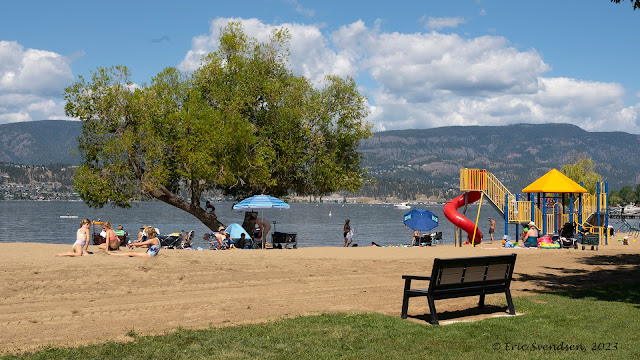
Rotary Beach in Kelowna, British Columbia What makes one shot better than another?  Assuming that the elements of any two shots are the same, what is it about one that makes it stand apart from the other?  The answer has to do with composition. I took this photo two days ago while my family and I were visiting one of the many beaches found here in Kelowna.  I took many shots, but this one was the best of the lot.  What is it about the photo that makes it any better than the other ones I took?  The image below gives you an idea. Same photo as above but with compositional awareness points. If you search through my many blogs (over 600 now), you will find a number of them deal with composition.  One of the greatest tools for producing attractive photos is using the rule of thirds.  Other important ones include using lines as pointers and guides, putting people in your shot, and the placement of both foreground and background elements that lead to a simple...

Adirondack chairs makes the shot

Image
Okanagan Lake at Kelowna, BC. I have discovered that 45 years of photography has given me an eye for when something is good.  Yesterday my family and I were at Rotary Beach in Kelowna.  After hanging out for two hours (a remarkable feat for me), I decided my camera needed to go for a walk.  I found a path that lead to a boardwalk and explored the sights.  It was there that I saw the chairs. I knew instantly that they would make an interesting photo.  Besides the colours and relative appeal of them, they formed an arc that helps to lead your eye toward the lake.  I needed to back up far enough and high enough to get the shot I was looking for; fortunately, there was a hill immediately behind me.  The APS-C sensor camera I was carrying sported a 24 mm lens that gave it a 36 mm relative focal length which was perfect for the image I wanted to capture. The other things in the photo I like are the willow tree off to the right and the waders just beside it....

More on leaf-cutting bees

Image
While walking along Okanagan Lake in Kelowna today, I came across an interesting bee species and shot it with my Zfc Nikon camera and 24-70 mm lens.  It is the first time I used the lens for closeup work, and I was pleasantly surprised to find that it does have a modest macro ability.   At home, I perused my images on the computer and noticed that the bee I had photographed had features similar to one I photographed earlier while in Alberta (see blog here ).  It turns out it was a leaf-cutter bee, the second one I had seen in as many weeks.  This one was particularly interesting though because the ventral aspect of the abdomen was yellow. In the previously mentioned blog, I had discovered that these bees collect pollen on the undersides of their abdomen.  The one I had photographed earlier either did not have any or it was hidden from the camera.  The one I shot today clearly has a ventral load of the stuff.  I thought that was pretty cool. The Un...