Posts

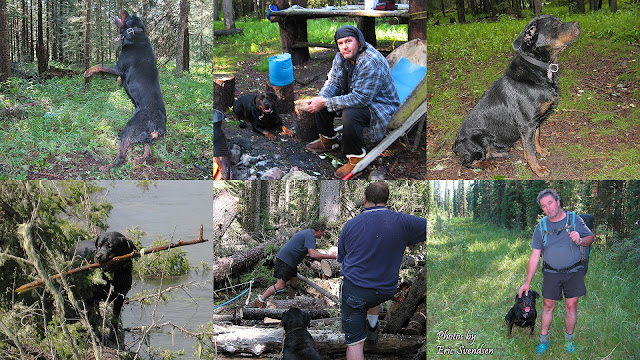
Klaus - What a great dog.
Image
Dell and Klaus.  Camping at the Cabin in August 2006. Klaus was an amazing animal.  He was a rottweiler and all muscle.  He was Dell's dog, and the both of them had a singular passion - they loved camping. I was always in awe of Klaus's skill set.  When he found a stick he liked he would carry it everywhere.  If you threw it, there was no challenge he couldn't be beat by.  Hang it from a tree (top left), he would eventually get it.  Toss it in a lake or river (bottom left) and he would swim to retrieve it eagerly.  Most impressively, in the pitch black of night, you could throw his prize into thick bush and he would disappear to search for it.  His dedication would always result in locating it, not some facsimile, and proudly return it to his master. Stick retrieving wasn't his only strength though.  He carried a pack on his back that contained his needed supplies.  He would sit nicely in a canoe for hours on end, happily watching t...

Male and female flower crab spiders - it was amazing to watch them.

Image
Female spiders typically have the job of staying where they are, especially around breeding time.  Male spiders, usually smaller, are more likely to wander in search of food and females.   The female flower crab spider is the large white one in the above image.  The male is the much smaller blackish one on the end of her abdomen.  The size difference is significant, with the female being three to four times the length and 10 to 20 times the weight.   I noticed the female at the front of my house in Maple Ridge.  Later on, I found a male in the back yard.  Curiosity got the best of me and I introduced them to each other.  What happened next surprised me. I half expected the female to devour the much smaller male in a single bite, but instead, she remained still.  The male, on the other hand, became suddenly very active and crawled all over the female's body.  I have never seen anything like it.  No fear at all - his reactio...

Why teachers go on strike

Image
  Cindy Lacroix and Laura Richardson, Garibaldi teachers picketing in 2005 I have taught for 30 years and have been on strike three times.  In an ideal world, there would be no need for such actions.  Employers would recognize the value of employees and their need for work conditions conducive to everyone's well-being and production.  Although money is often a significant factor in the motivation to walk the picket line, there are other important issues that need to be addressed. For teachers, these issues include working conditions that facilitate the education of their students.  Every teacher I have known has a passion for helping children grow and being part of a system to develop the minds and bodies of our future.  It's about making a difference.   Making a difference in the lives of our youth is difficult when teachers are taxed beyond their ability to manage.  Too many students in a class, too many individuals with special needs that ...

Camouflage in lizards - A side-blotched lizard in Arizona

Image
Most lizards of the desert are carnivorous as plants often have a tough waxy cuticle and may also be equipped with sharp spines.  I have seen common side-blotched lizards in Arizona and California, although they are also present east toward Texas and south into Mexico.  They don't get much bigger than about 5 inches in length but are ravenous eaters of creatures they can fit in their mouths.  This includes insects, centi and millipedes, arachnids, and even small lizards. Their broken pattern of white and black spots on a brown field renders them very difficult to see.  They are crepuscular in nature, avoiding the hot sun or cool evenings.  They will hide in any available void in rock or earth unless they are actively hunting.  They will also bury themselves in sand.  During the early morning, they first come out to warm up in the sun and then oscillate between sun and shadow to maintain a reasonable inner temperature.  They also will raise their b...

Composition and the art making an image attractive

Image
Female Anna's hummingbird with honeysuckle flower What makes one photo more attractive than another?  Is it a perceptual thing or is it about inherent beauty?  The axiom, "Beauty is in the eye of the beholder" has a lot to do with it, but really it's not the eye, it's the brain. Part of what we understand to be beautiful is learned, but even this is based on the ability of our senses to observe what is around us.  Another part of our ability to consider something attractive is innate - our minds have a preset way of reacting to things.  And then there is the cognitive aspect of appreciation where we use our thinking skills to analyse what is in front of us. These three aspects of our biology are what makes an image stand out for us.  The learned component in the above shot would be the recognition of familiar components - the flower and hummingbird.  The innate part would be compositional guidelines such as our eyes following lines, using the rule of thirds...

Bowen Park waterfalls in Nanaimo, 2019, shot with Panasonic FZ2500

Image
Although not a DSLR, my Panasonic FZ2500 was a remarkable piece of equipment.  A bridge camera, its all-in-one body boasted a 24-480 mm zoom and used a 1 inch sensor to capture images.  It was my travel camera for a number of years, and I took it with me when we went to New Zealand.   The wonderful thing about this camera is how I came to own it.  I had announced my retirement from teaching and the staff from school threw me a celebration.  What's more, they passed the hat around beforehand and took up a collection, which was presented to me as a gift certificate to a camera store I was known to frequent.  The total came to a little more than $900 - a sum that quite frankly shocked me - and left me with the sense that I had made an impact after working there for 27 years. The camera was a great travel companion because it was small, powerful, and produced very good images.  The reason it is considered a bridge camera is because it does a lot more ...

Summer in Kelowna, 2021, shot with Nikon Zfc

Image
I decided to buy Nikon's Zfc camera, a 20 mp APS-C format classic design body, partly because it was on sale and partly because I wanted a second body for my Z series lenses.  I could use the Z7ii in crop sensor mode, which produces a 20 mp DX image instead of a 48 mp FX image, but the second body would give me some redundancy should my main camera fail. I actually haven't used it a lot, but I found the classic design appealing and now have it set up as a macro system.  I am hoping to get more use out of it this coming spring and summer when insect activity begins.   The one thing I don't care for is that it uses a different battery than all my other Nikon cameras.  The D600, 750, 7000, 7100,7200 and Z7ii bodies all use the EN-EL 15 battery and they are all interchangeable.  I have extra batteries that I keep charged so I can swap them out at any moment.  The Zfc uses different batteries and a different charger.  The reason, according to Nikon, is...