Posts

Ring-necked ducks - are they Daffy?

Image
A pair of ring-necked ducks (main image above) with another ring-necked duck (inset) - are they related? Evolutionary biology is based on two main parameters.  These are selection of the fittest and diversity within a population leading to members with more desirable traits.  Mutation plays an important role within this framework as it allows for unique genes to be created within a population to be weeded out through the selection process. Geneticists would tell you that most mutations are either harmful or fatal (99.9%), with many being a recessive trait that is not expressed unless in the homozygous condition.  Some mutations are neutral, meaning that their expression has no impact on an individual's chances of survival. What would happen if numerous genetic traits all came together to produce a bird with the characteristics of Daffy Duck?  In order to analyze this question, we need to break it down into three different categories. #1:  Physical likelyhood of ...

Savannah Sparrow eating an ant in Golden, BC

Image
Saying that a bird is a sparrow is like saying a vehicle is a car.  The general title does credit to narrowing its identification, but it still leaves much uncertainty.  In the world, there are 140 different species, of which 47 of them occur in North America.  In British Columbia, where I photographed this guy, there are about 18 different species according to Bird Watching HQ . Savannah sparrows are found throughout North America.  You would think that a sparrow named for flat temperate grasslands wouldn't range as widely as they do, but the irony here is that the name comes from where the bird was first identified.  It turns out that it was discovered in Savannah, Georgia, by a famous ornithologist in the 1800's. There are a lot of savannah sparrow subspecies.  These birds have a strong inclination to return to the area they were raised.  This means that gene pools become somewhat isolated and facilitate diversity within the population.  A good...

Redhead duck - common in Alberta

Image
As a Lower Mainlander for over 30 years, I never saw redhead ducks on my local photographic expeditions.  I had heard, on occasion, excited birders talking about photographing the odd migrant on Vancouver Island.  As I never saw them, I never took an interest in them.  Then, in the last few years, I have seen them in Alberta around Edmonton. It turns out that redheads are found only as migrants in western BC and do not show up in any numbers until the Okanagan.  However, they are fond of pothole ponds that are distributed throughout the prairies, and this is where I have seen them. You can tell a duck is a male redhead by the bluish bill with the black tip, the red head, golden eye, and gray back.  The females are brown overall and rather bland in colour.  They still have a black tip at the end of their bill, but it is not nearly as obvious given the dark colour of the rest of the bill fitting with the body colour. Female redheads may use brood-parasitism a...

Mourning cloak butterfly in early May, Alberta

Image
  While hiking Clifford E. Lee park (near Edmonton, Alberta) in early May, I came across a dull-looking brown butterfly that was sunning itself on a log.  I was unsure to its identification as I never saw the ventral wing display.  I photographed the inset some years ago, also in Alberta.  I included the image as a reference how the insect looks when its wings are open. Mourning cloaks belong to the brush-foot butterflies (Nymphalidea).  Notice that the butterfly in the above image is sitting on only four of its six legs.  The hind legs are curled up behind the butterfly.  This is a common trademark of the family.  The term "brush-foot" comes from the fact that they sometimes have brush-like hairs on the forelegs.  You can see just a hint of that in the image. Mourning cloak butterflies are some of the earliest Lepidoptera to be seen in the spring.  Adults may successfully overwinter and be the first on the scene, ready to breed and begi...

Northern rough-winged swallow - what's with the "rough wing"?

Image
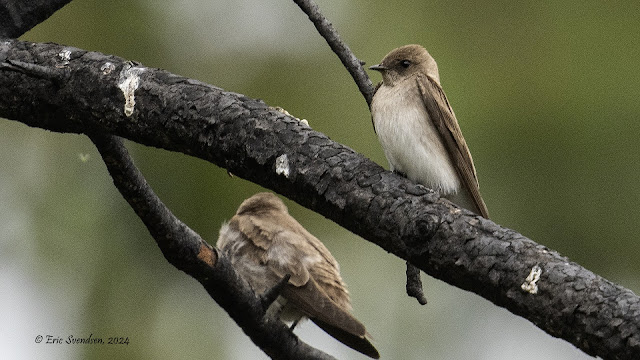
A small gathering of rough-winged swallows near a pond in Kelowna. Thanks to a number of helpful bird enthusiasts, I determined yesterday that my unknown flycatcher was actually a type of swallow I had never seen before.  After learning the name, I had to do some research on what the moniker "rough wing" was about.  I know that owls have frilled/soft-edged feathers to allow them to fly silently, so what is going on with this bird's so-called "rough" wings? You can see in the above image that the leading edge of the swallow's primary feathers has a series of hooks or barbs.  This gives the wing the rough feeling that you get when you run your finger across its edge.  This is unlike normal feathers that are smooth all the way along. The fact is that the purpose of these barbs is as of yet unknown.  There is some speculation that it may affect the sound of the bird's flight and may be involved in mating.  Given the dull appearance of the creature, I could s...

Northern Rough winged swallow

Image
Northern Rough Winged Swallow - a new species for me. There are a number of bird groups that I find hard to identify species in.  The ones that immediately spring to mind are gulls and flycatchers. The key to identifying a bird species is to look for morphology clues such as size and colour.  Particular features such as beak and leg form will often help you to identify a bird to at least the family level.  Beyond that, you need specifics such eye rings, breast pattern, wing or tail bars, and so on.  Habitat, behaviour, and location may also play a role in identification. In the example above, my thinking is that the bird is a flycatcher.  It doesn't fit any of the patterns for the swallows we have here.  There is no eye ring, no crest, and the bird is has a buff-coloured breast without a pattern and a brownish-coloured back, sides, and wings.  There are no wing or tail bars.  It is also small in size.  This leads me to believe it is either a ...

Violet-green swallow

Image
Although I have seen violet-green swallows before, I have rarely photographed them.  In fact, the body of the above photo was only the third time I have managed to record an image of one.  The inset I photographed in 2011 with a Nikon D7000 and a 70-200 mm f/2.8 lens sporting a 1.7x teleconverter.   The main photo above was shot with a Nikon D500 with a 500 mm PF lens and a 1.4x teleconverter.  It was a dull day when I was out and the f/8 minimum aperture meant that I had to use an ISO of 1600 in order to pull off a decent shutter speed. Although my D500 performs much better than my D7000 ever could, I find that I can't use focus tracking on it when the minimum aperture is f/8 (probably not enough light for the system).  It works fine when shooting at the lens' native f/5.6 aperture. I have not taken the time yet to uncover the species of bird behind the swallow, but I suspect it may be a flycatcher of some form.  The dead tree was home to quite a grou...