Posts

What is the value of a friend?
Image
I have written on this subject before, but it is pressing on my mind and I have to express it to anyone who will hear me. Friends are important. I am not talking about acquaintances, people you meet socially, or even those you might have over to the house for an evening together. I am talking about the kind of deep friendship that comes with a commitment for life. Every relationship will face trials. They could be in the form of a disagreement, competition over something, or a wrong that was carried out, one against the other. Think hard about the people in your life where such matters are trivial compared to the value of their friendship. This is where forgiveness comes in. In your heart, you can say, "In spite of the fact that this event has happened, there is nothing that will make me turn away from you." There is another expression for this concept, one that does a far better job at explaining the nature and depth of the relationship. Unconditional...

As the sun sets the children are in awe at the beauty of Writing in Stone Provincial Park.

Image
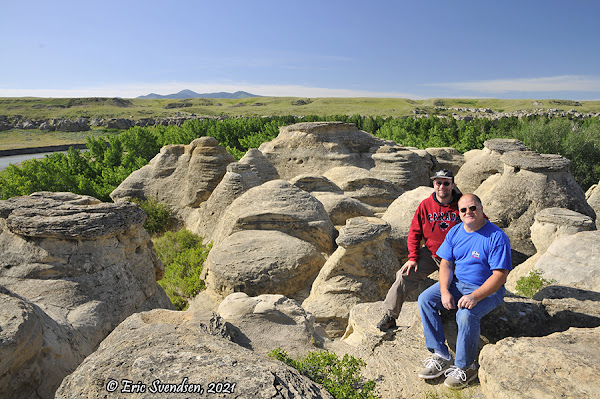
What could be better? Warm rocks to climb, a late summer's eve with the waning sun rendering its last vestiges of light before slipping beneath the horizon, and a beautiful landscape to be in awe of. The perfect way to end a perfect day. I find that my memories of growing up are few and faint, especially the ones before the age of eight. One of the things that help fix an event firmly in your mind is an emotional experience; the stronger the emotional response the greater the chance that memory will carry through the rest of your years. I can imagine the children in the scene will always carry something of that remarkable evening with them. These events are formative in nature; they are part of the hand that molds us into who we are. Children who are given the opportunity to experience nature's great beauty are more likely to respect and care for the Earth they live on. The reason is two-fold. First, these memories are likely to form an unconscious need to ex...

Back from near extinction

Image
British Columbia has a population of 20,000 to 30,000 bald eagles. Most of them can be found along our coastline. Counts in the Fraser Valley have gone as high as 7,362 bald eagles . Being top carnivores, that is an impressive number of these large, majestic birds. Topping that, Alaska boasts a population of some 70,000. The species seems to be doing well. That has not always been the case though. Back in 1782, when the US adopted the bald eagle as its national bird, there was an estimated continental US population of 100,000 breeding adults. Despite that honour, war was unofficially declared on the species in the mid to late 1800s. Every conceivable method of eradication was employed, some intentionally and others not. This resulted in a tumultuous decline to the extent that, in 1963, there were only 487 nesting pairs known to be left ( click here for more information). The greatest contributor to their demise was the nation's desire to control mosquito population...

The Rock Cycle - Neither music nor tranportation.

Image
The truth is that if I hadn't gone to post-secondary in Biology it could have been in Geology - the study of rocks. I've been told on occasion that I had rocks in my head, but they couldn't have guessed that it was true. I have always been fascinated by rocks. The word "rock" hardly does justice to the concept. A rock isn't just some hard thing you stand on, skip across the water, or use as a building material. Rocks form the bulk of the Earth's crust, a layer that makes up the surface of the planet we call home. Ranging from 20 km to 120 km thick, it is comprised of over 2000 minerals that go into making it up. So, what's the difference between rocks and minerals? A mineral is a pure substance, composed of only one kind of element or type of molecule. Silicon dioxide (made of 1 atom of silicon and 2 atoms of oxygen) is the molecule that makes the mineral quartz. Add some feldspar, biotite, and mica to that and you have basalt. Let mol...

Thorn Hill hike and what to expect.

Image
I have lived in Maple Ridge for almost thirty years but have never hiked the Thorn Hill area. Part of the reason is that I haven't been particularly aware of it, the other has to do with the word "hill". One of the things I like about this part of the world is the number of hikes, dikes, and parks that team around me, and most of them have little in the way of elevation gain. This trail though has moderate slopes throughout its length. The entire trail, as indicated on the Hiking Project website is 10.4 km; I did only about 3 km of it. I was inspired by a friend's post. It was the photograph he included of a Northern Pygmy Owl that stirred me into action. Yesterday, with the sun out and my camera begging to find some action, I began my quest. I wanted to find the mysterious "small duck pond" that he mentioned. I had to backtrack several times along the trek as it seemed I went the wrong way but eventually came upon the standing body of water...

American widgeon pair - the advantage of viewing ducks from a dike.

Image
If you are fond of birds then you know they generally keep their distance. One of the best ways to scare off a bird is to simultaneously look at it and approach it. The combination tells the bird that your interest in it may be much more than arbitrary. There could well be a nefarious purpose behind your actions. If you want further proof, just watch a few episodes of the Road Runner with his nemesis, Wile E. Coyote. The scene is something out of a classic western with gigantic columns of red sandstone intertwined with a winding road. A villainous coyote keenly views his prey and approaches it with some mysterious apparatus. As the antagonist gets closer, our hero sees a pair of red-rimmed eyes approaching. A natural and rising sense of dread fills the roadrunner; proximity necessitates reaction. It's move or become a meal. With a rumbling tummy and a drooping snout, the coyote watches as another lunch gets away. It is not too different when you approach a bird...

Pointing your shadow.

Image
Photography is all about controlling light. Although you can't control the sun, you can control your position relative to it and the time you choose to photograph something illuminated by it. These are two key elements in photography; when and where. You don't always have the luxury of controlling the when and where of things, but you can certainly try. I find the best time to do my outdoor photography is in the morning when the sun's angle to the ground is relatively low. In the summer time, this means getting up early because the sun will be producing harsh lighting by mid-morning. In the winter, especially around the winter solstice, just about any time will do (true in Canada, not so much as you go further south). Whether shooting landscapes or wildlife, I like to know where the sun is relative to my subject. I find that I get the best wildlife photos when the sun is low and directly behind me. The angle of the sun has to do with the season, time of ...