Posts

House wren - around, but never seen

Image
A house wren with a moth - waiting for me to move along and return to the nest. I have never seen a house wren before.  They are somewhat ubiquitous in North America from the mid latitudes of the western provinces and from southern Ontario through the Maritimes down to Central America.  People have wren houses.  You may hear them singing ( click here ).  Even great poets such as Wordsworth have attributed prose to them.  But have you actually ever seen one? The house wrens has been broken into two separate species, the Northern and Southern House Wren.  There are also a few endemic variants found on some select Caribbean islands.  The one photographed above is the northern variety.  The southern species lives mostly in South America, many of them being year-long residents.   There are some interesting facts about house wrens.  I quite like the one about small parasites such as mites that infect the nesting cavities that they raise t...

Visiting friends and a camera trick - can you spot it?

Image
Eric, Kathryn, Judy, and Ron.  And our dog, Murphies. We had a great time visiting Lloydminster.  Ron and Judy Plett, friends of ours now for almost 40 years, have been excellent hosts as we camped out with them at their home.  The best part has been connecting again since the last time we saw them and enjoying their hospitality.  We set up our RV on their family farm and have been busy with sharing in their lives. Ron and I have been taking walks and driving around discussing whatever crosses our minds.  And, of course, looking for birds, or any other creatures that happen to cross our paths.  While visiting, I have managed to get some pretty great shots on their farm, my favourite being a yellow bellied sapsucker which you can see below.  I also photographed a house wren and song sparrow on their farm a host of other birds around Lloyd.  The coolest one was the eared grebe that I did a blog on yesterday ( link here ).  Male yellow bellied s...

Eared grebe - a bird I don't see very often

Image
Eared grebe on Neale Lake, Saskatchewan, near Lloydminster. I don't see these birds very often.  I was surprised to see two of them yesterday while visiting some water bodies just east of Lloydminster where I am staying.  Their dark feathering combined with their contrasting "ears" (cranial tuffs of feathers) and stark red eyes makes them visually engaging.  Yet, I have never managed to get a really good shot of one, little lone one with chicks. Eared grebes do not adhere to my understanding of what grebes do.  These guys tend to live in brackish waters, with or without fish, and feed mostly on invertebrates.  They prefer shallow waters where they may just dip their heads under the surface or dive to the bottom where they peck at any invertebrates they can find.  That certainly does not fit into the behaviours I see with red-necked grebes and western grebes. One of the reasons I don't see much of them is because they tend to live on the prairies where they ...

Bud Miller Park in Lloydminster, Alberta. A great place to see birds.

Image
Some of the birds I photographed while visiting Bud Miller Park in Lloydminster, Alberta. Cute does not begin to describe the Franklin's gull chicks I witnessed at the trout pond at Bud Miller Park in Lloydminster, Alberta.  Adorable was more like it, with a dash of OMG and being gobsmacked.  And then there was the discovery of the yellow-shafted flicker, which I wrote a blog on yesterday ( click here ).  If all that wasn't enough to get my attention, there were the blackbirds, geese, gulls, chickadees, and sparrows that were commonly seen.   One of the great things about seeing birds in parks is that they are acclimated to people.  They don't seem to mind our presence.  In some cases, I had to back away because the bird was too close to me to get a photo of.  That's not something that's commonly a problem for wildlife photographers.  I love my long lens that I use for such occasions, but the truth is you can get some pretty good shots with s...

Flickers - red shafted versus yellow shafted

Image
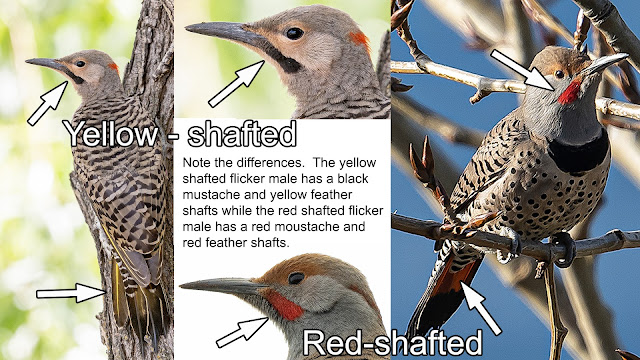
Top and left:  Yellow-shafted flicker.  Bottom and right:  Red-shafted flicker. Having lived in BC for the last 38 years, I have seen a lot of Northern Flickers, but they have all been of the red-shafted variety.  Yesterday, while visiting Lloydminster, on the border between Saskatchewan and Alberta, I saw my first yellow-shafted one.  The difference was quite stark.   Male red-shafted flickers have a red moustache while the yellow-shafted variety have a black moustache.  There also seems to be a bit of crown colouration differences, although I don't know how consistent this is between groups or plumage variations.  The main difference, for both males and females, is the stark colour of the feather shafts which is yellow in one and red in the other.  Although this difference is a little hard to see when the bird is sitting, it becomes more obvious when flying if you can get a good look at it from underneath. The birds both belong to the ...

Plains garter snake found dead – victim of brutal stomping.

Image
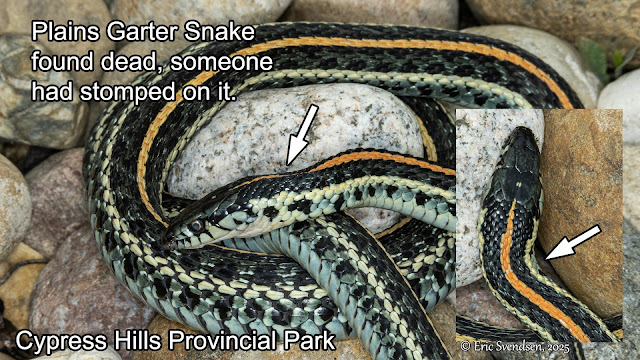
The arrows point to the injured area of the snake that led to its death. I am always on the lookout for snakes – not because I fear them, but rather because I find them wonderful and amazing creatures.   I found one today, but not in the good way.   Some children were looking at what appeared to be a stick until I realized it was a dead snake.   They found it and brought it to a washroom/shower building at the main lake in Cypress Hills Provincial Park. They wondered why it had died and there was some conjecture such as an animal did it, it was from natural causes, it was old.   But the tiny little bit of blood at the mouth and the odd way its neck was bent/dented told a different story.   It had been a victim of blunt trauma, likely from someone’s foot, and likely on purpose. It is hard to know what happened for sure, but knowing that some people hate snakes and others are just plain mean, I can well imagine the chain of events.   The snake, trying to ...

Plains (Prairie) Garter Snake - the largest garter I have ever caught!

Image
Plains garter snake I caught in Lloydminster.  Top center - a dead one I found at Cypress Hills. I have never been bitten by a snake before.  Well, that's not quite true.  I have a corn snake at home and it did once get a hold of me.  But today was the first time that a wild snake ever laid teeth on me, and it drew blood.  I can't say that I am very surprised by that.  Small snakes tend to not be very aggressive, and this was the largest snake I have ever caught - of any species.  I had heard that large garters can be aggressive and bite.  Today, I can confirm that hypothesis. It actually lunged for me a couple of times, missing my nose by a few inches once and other bodily parts other times.  I held it for a few minutes and then released it back where I found it.  Although I often catch snakes, they always get released and I handle them gently, even when they bite me.  Snakes do carry Salmonella; I have been made ill by breathing i...