Posts

Feeling Ripped of at Kelowna Chrysler Dodge Jeep Ram.

 I am very angry.  I made it clear to the salesperson that I had two vehicles to trade in for a truck that I was interested in.  I told him clearly that I was willing to deal if I could trade in both vehicles and pay an additional $10,000.  The vehicles included a 2014 Jeep Cherokee Trailhawk (80,000 km) with flat tow braking gear and 8000 lb warn winch and 2008 HD Ford F150 XL with club cab, 8' box, bed liner, canopy, and roof rack.  We talked for an hour, went for a test drive, talked some more, and he had my jeep reviewed for its value. I returned home with the jeep and came back later that afternoon with my half-ton to have it inspected as well.  The salesperson could have talked to me about the value of the jeep, raised some concerns, but instead went on as if there were no issues.  As a result, my hopes got raised and, in my mind,  I was developing future plans for using the truck to go camping this summer.   I was told a 2016 mode...

The balance between ISO and shutter speed.

Image
When photographing wildlife, sports, or anything moving, shutter speed is an important parameter to consider. Low shutter speeds risk blur from both subject and camera motion. Cooperative subjects, panning, and vibration compensation (in-body and lens) may allow for slower shutter speeds. A good strategy is to photograph the subject in the desired manner and play the resulting image on the sensor. Zooming in on the shot will confirm the viability of that choice. Higher shutter speeds are often necessary but are difficult to achieve given the amount of available light and the minimum aperture value of long lenses. Most of us are not in the position to purchase long, fast lenses as their cost can exceed ten thousand dollars. The only alternative then is to adjust the camera's ISO to achieve the required shutter speed. Higher ISO numbers mean faster shutter speeds can be achieved. Although this seems like a simple solution, there are potential repercussions. Altering ISO changes the a...

Hooded merganser - an early arrival.

Image
Spring is my favourite season.  Aside from thawing out and plants showing signs of life once again, it is the appearance of birds that I am most thankful for.  Many of them also are showing up with breeding plumage in full regalia.  A prime example of that is the hooded merganser.   It is mid-February and winter's bite has waned somewhat.  On the west coast, daffodils are blooming and the snow has long disappeared.  Here, in central BC, evidence of change has gone from whispers to mild utterances, the loud din of spring yet to raise its head.  In spite of it still being winter here, certain birds have started to arrive.  A couple of days ago I was out hiking around a small lake.  Although the ice was still covering its surface, a few openings occurred along the shoreline.  That was where I saw the male and his apparent harem. Mergansers are fish-eating ducks.  They are one of the last birds to migrate south in the fall and...

The lens makes a difference.

Image
  As I have lived in the Lower Mainland of BC for 30 years, I have had many opportunities to photograph great blue herons.  Over that period of time I have photographed them with negative and slide film and a host of digital sensors.  Although the camera has had some impact on the quality of the image I could attain, I have to say that the real deciding factor has been the lens. My field equipment reflects my passion for wildlife.  I have owned about a dozen different lenses with a focal length of 200 mm or more.  These include a number of prime lenses (2 - 200 mm f/4 lenses, 2 - 300 mm lenses {f/4 and 4.5}, and 2 - 500 mm lenses {an f/8 mirror and f/5.6 PF).  I have also owned a number of zooms including a 100-300, a 28-300, an 80-400, and two 150-600s.  I have also used a 1.7x and a 2x teleconverter. All of them have allowed me to photograph wildlife, but I have to say that, in general, the primes are superiour to zooms.  Longer focal lengths me...

The fate of the planet.

Image
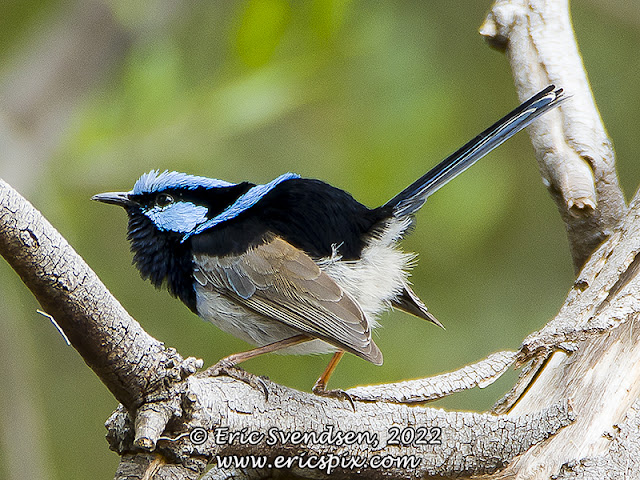
The above photo is of a male splendid fairy-wren, a bird indigenous to Australia.  I photographed it during the height of breeding season; it was vigorously chasing a potential mate.  I followed the antics of the creature during the pursuit.  It paused, only for a moment, but long enough for me to capture this image.  Then it was a streak of black and blue again obeying its nature and the drive to procreate. Nature has a way of balancing the forces of life.  Populations wax and wane over time with many factors at play.  The availability of food, number of predators, weather, and a host of other biotic and abiotic influences are responsible for this endless cycle.  The only species on the planet that does not follow this pattern is mankind.   We are clever and have the dexterous ability to create and manipulate tools.  Our success has been logarithmic with the population exploding to unsustainable values.  Our success in overcoming d...

Using HDR on a hay rake and house.

Image
HDR stands for high dynamic range.  It is a method of capturing details in an image that would otherwise be lost due to there being too much or too little light.  HDR employs bracketed photos of a specific scene.  There are a number of ways to create an HDR image, but so far the best way is to do so manually rather than using a built-in camera function. The above photo resulted from combining 5 images, each separated by a full stop.  The first was shot at 1/500th of a second and the last at 1/8000th of a second.  I altered the shutter speed and not the aperture to keep the depth of field the same.  The photos were done on a tripod to prevent ghosting.  It is possible to shoot such images handheld, but the end result is generally not as good. There are a number of applications that can do this.  I have used Photomatix and Photoshop CC.  There are many sliders that you can adjust to alter the way the image looks.  The image can be processe...

Fabulous facts on feathers.

Image
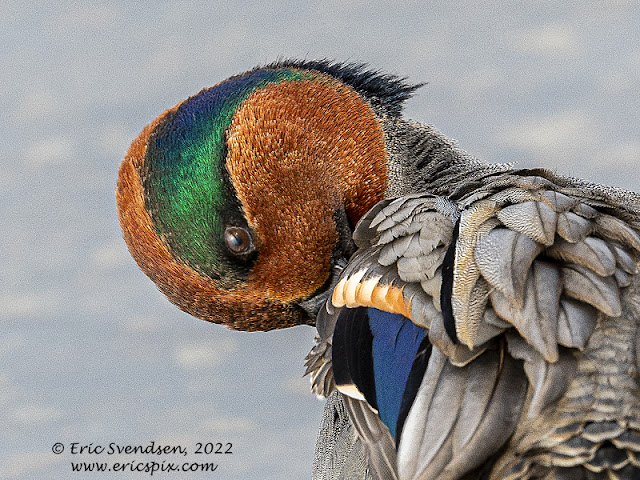
 Feathers are remarkable things.  On a single bird, ducks specifically, there are over 10,000 of them (link here ).  It turns out that birds possess six different types of feathers.  These include contour feathers, semiplumes, down, filoplume feathers, bristles, and powder down.  If you want to read up more on these, click here . Pin feathers are newly formed feathers that are just beginning to grow.  They are also referred to as blood feathers.  These are feathers that have an ongoing blood supply to them to facilitate growth.  Larger pin feathers may have significantly vasculated follicles that may bleed if the new growth is removed.  Heavy bleeding from these areas can result in death. Consider that each feather has a type, size, colour, and purpose.  The feathers are replaced at least once a year, sometimes twice if there are breeding and non-breeding plumages.  If a feather gets damaged it is not replaced.  Replacement hap...